Key Points
- Origin: clone variety found by Tyler Halvin in a wild population in northwestern Missouri (USA); named after the breeder's son.
- Ripening: very early (late July – early August in the USA); in temperate climates – September (mid-late).
- Fruit: large (225–510 g), sweet with notes of pineapple, banana, mango; creamy pulp, elongated-oval shape.
- Yield: high, regular with pollination; fruiting from 3rd–4th year.
- Growth: moderately fast, tree 4.5–6 m high.
- Pollination: self-infertile, requires cross-pollination (another variety); pollinators – flies/beetles.
- Hardiness: down to –25...–28 °C (USDA 5–9); adapts well to temperate climates.
- Resistance: high to diseases/pests; low-maintenance tree.
- Notes: very sweet taste without bitterness, productive in cool climates.
Variety Description
Origin and Breeder
Caspian is a clonal variety of Asimina triloba found by American fruit enthusiast Tyler Halvin. It was discovered in a wild population in northwestern Missouri (USA) and named after the breeder's son. It seems to originate from middle latitudes: some sources report the vine grew in Iowa (bordering Iowa and Missouri). As a variety, it began to spread in the 2010s–2020s through specialized nurseries.
Ripening Times
Caspian is classified as a very early-ripening variety. In the northern US states, fruits ripen as early as late July – early August, making it one of the first of the season. At the same time, under more temperate and later-spring climatic conditions (approx. USDA zone 5–6), ripening usually occurs later – mostly in September.
Cold Hardiness and Climate Adaptation
The variety has good winter hardiness. It is believed that pawpaws generally withstand minimum temperatures down to –25...–28 °C (approx. USDA zone 5) without damage. Accordingly, adult Caspian trees handle temperate winters well. Weakened or young saplings usually need mulching and light protection for the first 2–3 years. For normal growth and fruiting, pawpaw requires sufficiently warm summers – at least ≈150 frost-free days and 2200–2500 °C GDD (Growing Degree Days) per season.
Taste Qualities and Fruit Aroma
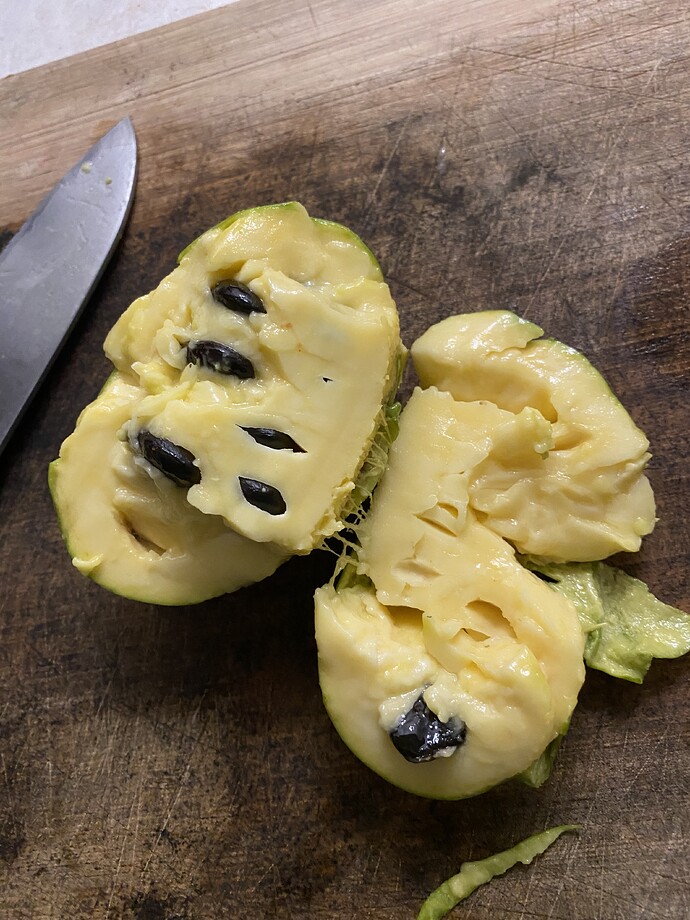
Caspian fruits are noted for a rich "tropical" taste. They are extremely sweet, with a complete absence of a bitter aftertaste. Descriptions mention bright notes of pineapple, banana, and mango (sometimes even "bubblegum" aromatic shades). The pulp is a creamy-custard shade, with a relatively dense, uniform texture. Overall, taste characteristics are close to the classic "banana" pawpaw aroma but with an enhanced fruity profile.
Fruit Size
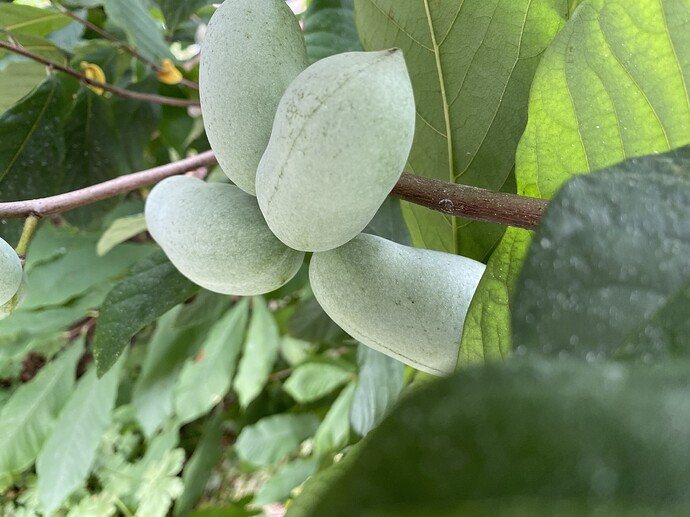
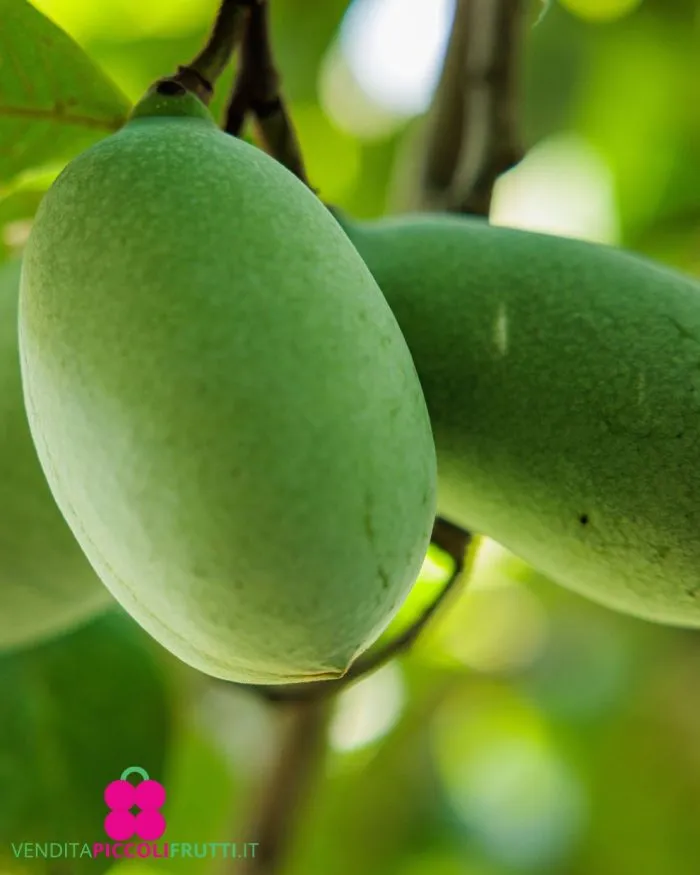
Caspian yields large fruits. According to descriptions, individual fruits weigh 8–18 ounces (≈225–510 g), noticeably larger than the average pawpaw size. The average weight is usually around 250–300 g. Fruits have an elongated-oval shape (similar to a banana) and light green skin that turns yellow during ripening. According to European descriptions, the large form and ample pulp make Caspian one of the high-yielding varieties.
Yield and Fruiting Regularity
Caspian is characterized as a high-yielding variety. Descriptions mention the tree gives an "extremely productive" crop annually. Saplings typically begin fruiting in the 3rd–4th year after planting. As with other pawpaws, yield can decrease without proper pollination. Fruiting regularity (with sufficient pollination and care) is usually good – trees bear fruit every year.
Growth Vigor and Adult Tree Size
In terms of growth vigor, Caspian is a typical pawpaw representative: moderately fast growth and medium size. Adult trees can reach 4.5–6 meters in height (15–20 feet) and approximately the same crown width. This is slightly below the maximum sizes for pawpaws (up to ≈7 m), which facilitates crown shaping. Usually, a single trunk forms with rough gray bark. Compact forms can be maintained with proper pruning.
Pollination
Like most cultivated pawpaw varieties, Caspian is not stably self-pollinating. It belongs to self-infertile forms: pollen from another genetically distinct pawpaw tree is required for fruit formation. Without this, pollination is very unlikely, as pawpaw flowers are typically pollinated by flies and beetles. It's worth noting that some descriptions occasionally mention self-pollination for Caspian; however, this contradicts general gardening experience and cited sources recommending cross-pollination. In case of pollinator insect deficits, manual pollination or dense grouping of at least two varieties is recommended.
Disease and Pest Resistance
Caspian inherits general resistance from the species: it is a "stable and low-maintenance tree". Special protective treatments are usually not necessary.
Cultivation in Temperate Climates
Caspian is recommended specifically for regions with temperate-continental climates and short summers. It withstands conditions in the northern US states (zones 5–6) well. Gardeners from the UK also note that Caspian "fruits and ripens very well even in cool climates". Similar assessments are observed in central Europe. Thus, experience shows the variety can adapt well to northern and western European conditions with sufficient summer heat.
Gardener Reviews
Overall, reviews for Caspian are positive. Experts and hobbyists alike praise it for its impressive sweetness and bright fruit aroma without bitterness. For example, Hillbilly Pawpaws representatives describe Caspian as a variety with a "very sweet taste, no bitter aftertaste, with strong fruity notes". Gardeners also note that Caspian trees fruit abundantly with proper pollination, creating many large fruits. Overall, the variety receives high scores for fruit quality and successful cultivation in regions with moderate climates.
Research: Detailed Description of Caspian Pawpaw Variety
Table: Summary Technical Card
| Characteristic | Description |
|---|---|
| Origin | clonal variety found by Tyler Halvin in a wild population in northwestern Missouri (USA); named after the breeder's son. |
| Ripening | very early (late July – early August in the USA); in temperate climates – September (mid-late). |
| Fruits | large (225–510 g), sweet with notes of pineapple, banana, mango; creamy pulp, elongated-oval shape. |
| Yield | high, regular with pollination; fruiting from 3rd–4th year. |
| Growth | moderately fast, tree 4.5–6 m high. |
| Pollination | self-infertile, requires cross-pollination (another variety); pollinators – flies/beetles. |
| Hardiness | down to –25...–28 °C (USDA 5–9); adapts well to temperate climates. |
| Resistance | high to diseases/pests; low-maintenance tree. |
| Notes | very sweet taste without bitterness, productive in cool climates. |