Key Points
- Origin: created by Tom Wahl at Red Fern Farm, a hybrid of Shenandoah × Susquehanna.
- Hardiness: down to -20...-30°C, USDA zones 5–9; adapts well to cold winters.
- Ripening: late (September–October); harvest before frosts.
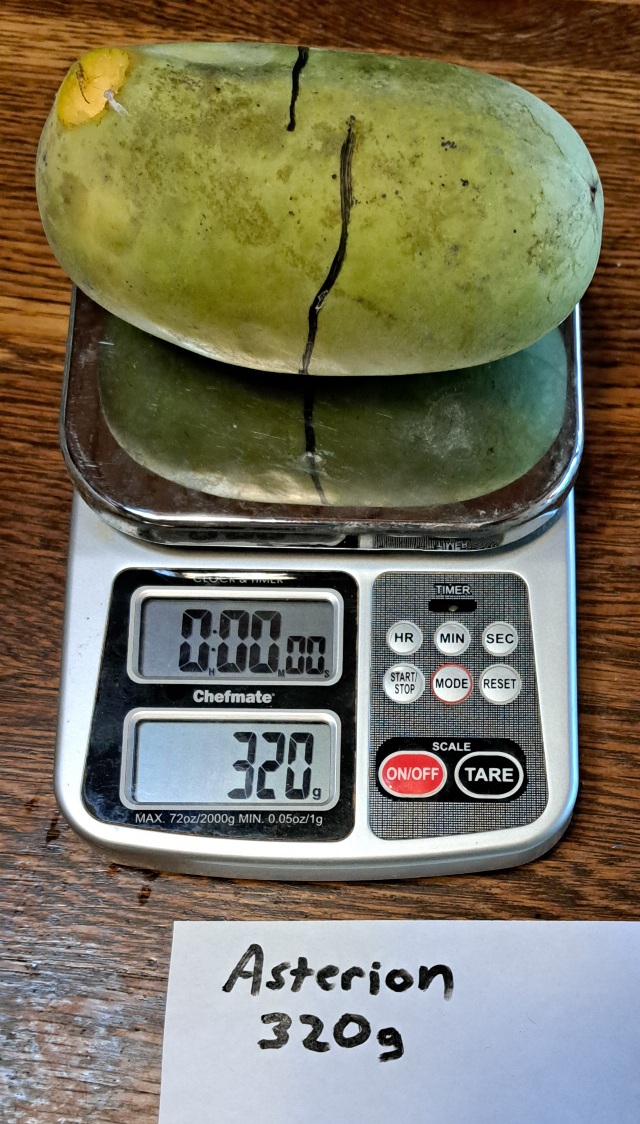
- Fruit: large (0.5–0.7 kg), yellow-green skin, creamy pulp, tropical taste (banana, mango, melon).
- Yield: high, hundreds of fruits per adult tree; regular with pollination.
- Tree: 4–6 m, multi-stemmed, sparse canopy.
- Pollination: cross-pollination required, another tree needed.
- Resistance: high, few diseases/pests.
- Cultivation: successful in similar climates (Ukraine, Romania); requires moisture in summer.
Variety Description
Origin and Breeder
The Asterion variety was created in the USA at the Red Fern Farm (Iowa) breeding program under the direction of Tom Wahl. The name "Asterion" is taken from a star in the northern sky. Asterion is a cross between the best cultivars Shenandoah × Susquehanna (a "Shensus" type hybrid). Red Fern Farm grew Asterion from seed as part of experimental breeding, resulting in a late-ripening variety with large fruits, few seeds, and excellent taste.
Cold Hardiness and Climatic Adaptation
Like all pawpaws, Asterion is intended for temperate climates with cold winters. The species as a whole can withstand sub-zero temperatures down to –20...–30 °C (USDA zones 5–9). The variety is noted for its high winter hardiness and tolerates frosts well. Overall, Asterion shows good adaptation in temperate climates similar to the USA and is successfully cultivated in the soils of Eastern and Central Europe (Ukraine, Romania, Slovakia, etc.).
Fruit Ripening Times
Asterion ripens in the late season. In the USA (mid-September – early October), fruits usually ripen after most other varieties. In regions where the first frosts arrive around October 10th, this means harvesting in late September or early October, depending on the weather. Due to late maturity, one should be prepared to harvest shortly before the first frosts. In shorter seasons, fruits may ripen a bit earlier but retain the "late variety" characteristic.
Taste, Aroma, and Texture
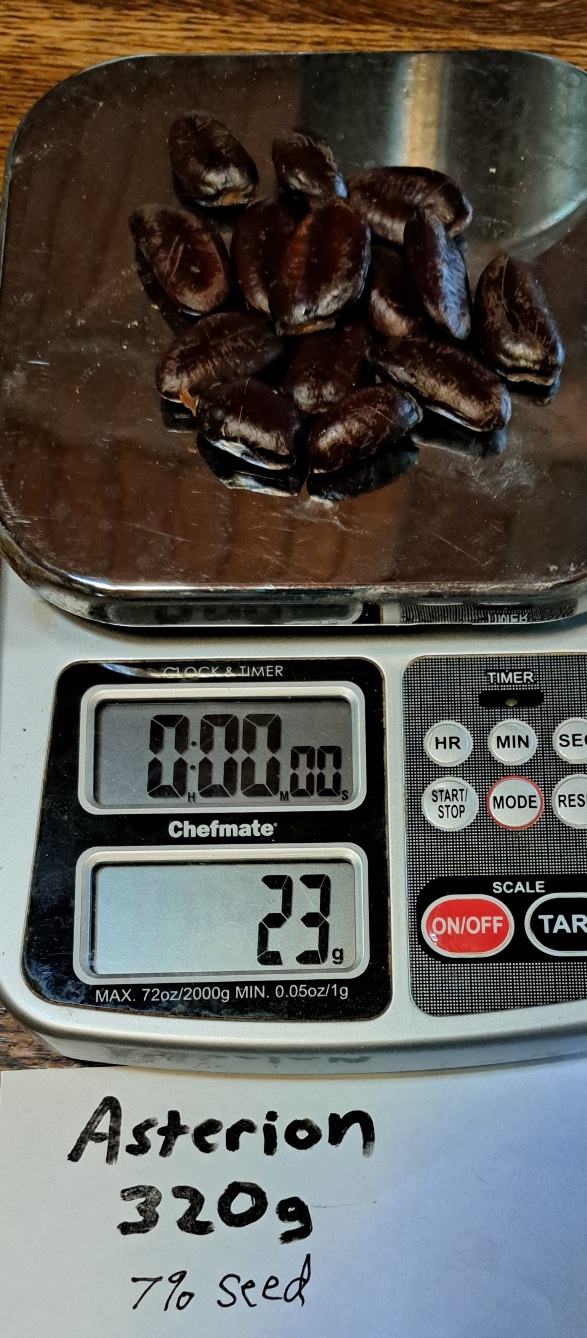
Asterion fruits are large, ellipsoidal in shape (approximately ~10–15 cm long). In the late stages, the skin becomes yellow-green with brown spots. Inside is juicy, creamy ("dessert") pulp of a rich yellow or orange color. The taste is intensely tropical, with noticeable notes of banana, mango, citrus, or melon. The aroma is very strong, "sweet-earthy", easily perceptible when ripe. According to breeder descriptions, Asterion has an impressively rich, sweet taste and pleasant aroma. The fruits have few seeds (less than 10% of the fruit weight), so most of the volume is fragrant pulp. Overall, the taste and texture of Asterion are rated very highly: the fruits are soft, creamy, and easily eaten with a spoon.
Fruit Size (Mass, Shape)
This variety yields exceptionally large fruits – usually around 0.5–0.7 kg, sometimes up to 0.7 kg without thinning flowers. The shape is elongated, close to oval or pear-shaped, although exact shape data for Asterion is not official.
Yield and Regularity of Fruiting
Asterion is a productive variety with intense fruiting. According to breeders, this variety forms a "huge crop" of fruits. Older trees can yield hundreds of large fruits annually if properly pollinated. With full pollination, varieties obtained at Red Fern Farm usually fruit annually. Descriptions note that the crop fits well into the fruiting rhythm and provides stable yields in the absence of extreme weather stresses. It is also important that Asterion's blooming and ripening are later, which can complement other varieties and extend the harvest season.
Tree Size and Growth Vigor
Asterion does not stand out particularly from other varieties: it has growth typical for pawpaw – rare shoots sometimes don't develop for a long time after planting, then the canopy quickly shoots up after a few years. The trunk is thin, the bark gray and smooth. An adult tree forms a wide top with long leaves. With high yields, the canopy may sag under the fruit. There is enough light for optimal growth, but in shaded areas, growth may be slower. Pruning is usually done only for shaping or removing damaged branches – in cultivation, this is a large tree with a sparse canopy.
Pollination
Like most varieties, Asterion is not self-pollinating. For fruiting, it requires the presence of at least one other genetically distinct tree (another variety) nearby.
Disease and Pest Resistance
Asterion is generally resistant. Sources state: "no serious diseases or insect problems" and that the tree is even resistant to deer (domesticated trees are usually not affected by wild animals). Thus, Asterion almost never requires chemical protection.
Cultivation Experience in Similar Climates
Asterion is well-suited for climates with warm summers and cold winters. As a temperate North American variety, it is successfully cultivated in the northern US states (zones 5–6) and is also already known in Eastern Europe. Scientific publications show that pawpaw is cultivated in Romania, Italy, Ukraine, Slovakia, and other similar climatic zones. It is believed that pawpaw develops optimally where summers are hot enough (at least 800 hours of warm weather above +13°C) and winters average no lower than –20°C.
Where to Buy
Since Asterion is a newer North American cultivar, its planting material is most often available in the USA at specialized nurseries. For example, Red Fern Farm previously offered saplings. In Europe, the variety is currently very rare.
Gardener Reviews
According to practical observations from enthusiasts, Asterion stands out for its large, tasty fruits with a high pulp content and few seeds. Its taste is described as particularly sweet and rich. For example, breeder descriptions and reviews emphasize "excellent taste, large size, and low seed count". Asterion yields very high harvests of sweet, aromatic fruits (some report individual specimens up to ~0.7 kg). Overall, reviews are positive: people like the "creamy, tropical" taste and the large soft center of the fruits of this variety.
Conclusion
Asterion is a promising new pawpaw variety from the USA, bred by Tom Wahl (Red Fern Farm). It combines late ripening (end of season), high fruit weight, intense sweetish taste, and high yield. It grows as a small tree or multi-stemmed bush (4–6 m), with slow development. Cold hardiness allows it to be grown in many temperate climates (zones around 5–6), but the need for moisture in hot summers should be taken into account. For crop formation, pollination by another pawpaw variety is necessary. The variety is rare in Europe but available through some American nurseries. Gardeners note its powerful flavor potential and yield, so Asterion is considered one of the most promising new crops in the Annonaceae family.