Key Points
- Origin: Ford Amend selection (Portland, Oregon, ≈1950).
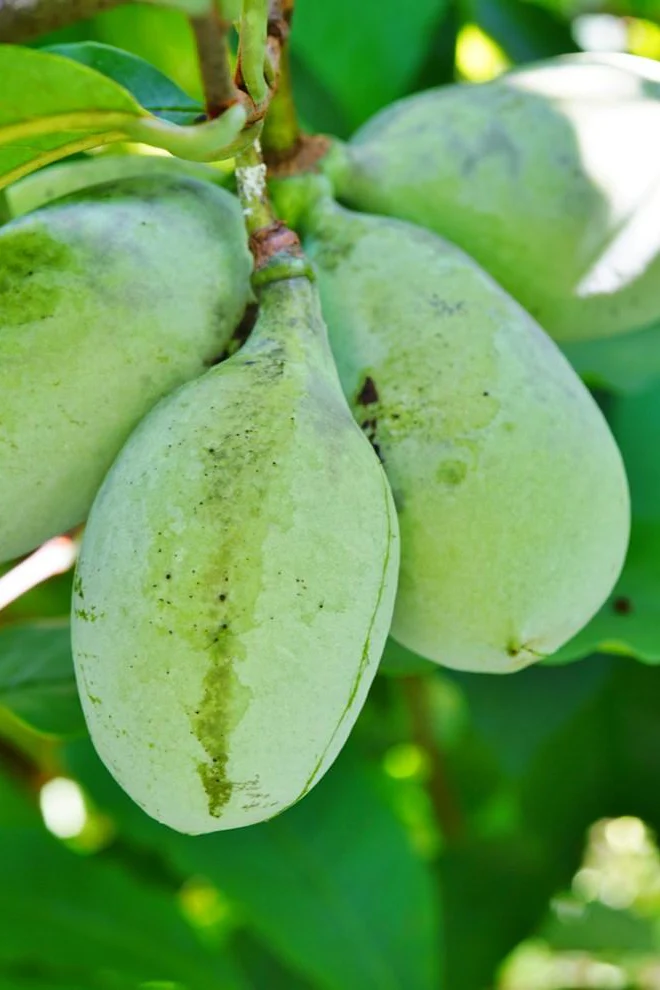
- Fruit: medium (~125 g), green-yellow skin, orange/golden pulp, pleasant taste.
- Ripening: very early/early (late September).
- Yield: productive, improves with thinning.
- Tree: 4–6 m, medium growth.
- Hardiness: USDA 5–9, down to −25...−28 °C.
- Pollination: cross-pollination required, another variety needed.
- Availability: rare, in specialized nurseries.
Variety Description
Origin and Registration
Origin: selected from a wild seedling by Ford Amend around 1950, originating in Portland (Oregon), US Northwest. This is a classic "chance seedling".
Fruit Description
Appearance: skin is greenish-yellow (often remains green when ripe by some observations). Pulp: orange/golden flesh — a unique trait, often noted in variety cards. Texture and Taste: creamy; flavor is described as "flavorful" — pleasant, classic for pawpaw. Average Weight: ≈125 g/fruit per KSU trials (this figure appears in reviews/catalogs citing the research). Note: in different conditions and with thinning, fruits can be larger.
Ripening Times
Very early/early: in comparisons Ford Amend ripens earlier than selections like ‘Sunflower’; in Oregon ripening was noted in late September. This makes it useful for sites with shorter ripening seasons.
Yield and Garden Behavior
Precocious fruiting: several sources describe Ford Amend as “precocious/productive” (early bearing and productive) — but quantitative multi-year data (kg/tree) is limited. Thinning often improves fruit size.
Growth Power, Tree Height
Typical for Asimina triloba: tree/shrub ≈4–6 m in height under favorable conditions. In available sources Ford Amend does not stand out with a special habit compared to other varieties.
Cold Hardiness/USDA Zones
USDA Zone ≈ 5–9 (withstands moderate winter minimums — adult trees are more resilient). This is confirmed by nursery and botanical database cards.
Pollination
Cross-pollination is required. Like all pawpaws, Ford Amend is not reliably self-fertile: plant another genetically distinct variety nearby or apply manual pollination for correct fruit formation.
Diseases and Pests
No specific known vulnerabilities for Ford Amend are recorded in sources; general species problems (leaf spots in wet years, local pests, short shelf life) are relevant. Standard agro-husbandry (ventilation, mulch, sanitary pruning) is recommended. Likely well-adapted to the Pacific Northwest and other challenging pawpaw zones with cool summers. May have resistance to BSD (Blue Stem Disease) — a disease that kills most pawpaws planted in the Northwest region.
Availability (Sale)
Rare/periodically available. Ford Amend is sometimes offered by specialized nurseries/online sellers.