Key Points
- Origin: wild selection from northern Missouri/Illinois, popularized among enthusiasts.
- Fruits: medium–large, creamy pulp, strong fruity flavor, low seed count.
- Ripening: mid-season (August–September).
- Hardiness: USDA 5–8, suitable for cold regions.
- Pollination: cross-pollination required, another variety needed.
- Resistance: natural resilience, no specific issues.
- Reviews: positive for taste and fruiting in cool climates.
Description of Danae’s Creekside Variety
Origin and Discovery
Common mention in communities: "Danae’s Creekside — a selection named after Danae, found in northern Missouri." This version is echoed in forum discussions and several nurseries/sellers. Other records: some catalogs mention Danae’s Creekside alongside historic selections (sometimes linking it to Corwin Davis materials). This suggests possible local variants or ambiguity in registration. The most widely accepted version is that Danae’s Creekside is a wild selection from the Midwestern US (northern Missouri/neighboring states); as an "official" clone, it was picked up by local breeders and spread among pawpaw fans.
Synonyms and Search Terms
Search for: “Danae’s Creekside”, “Danaes Creekside”, “Halvin’s Danae’s Creekside”, sometimes simply “Creekside”. In some lists, it may be mentioned alongside Halvin/Sidewinder under "local selections".
Fruit Description — Size, Texture, Taste, Seeds
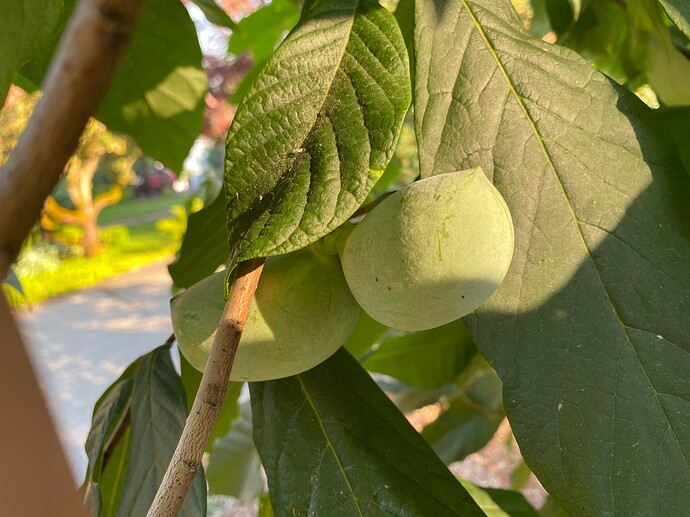
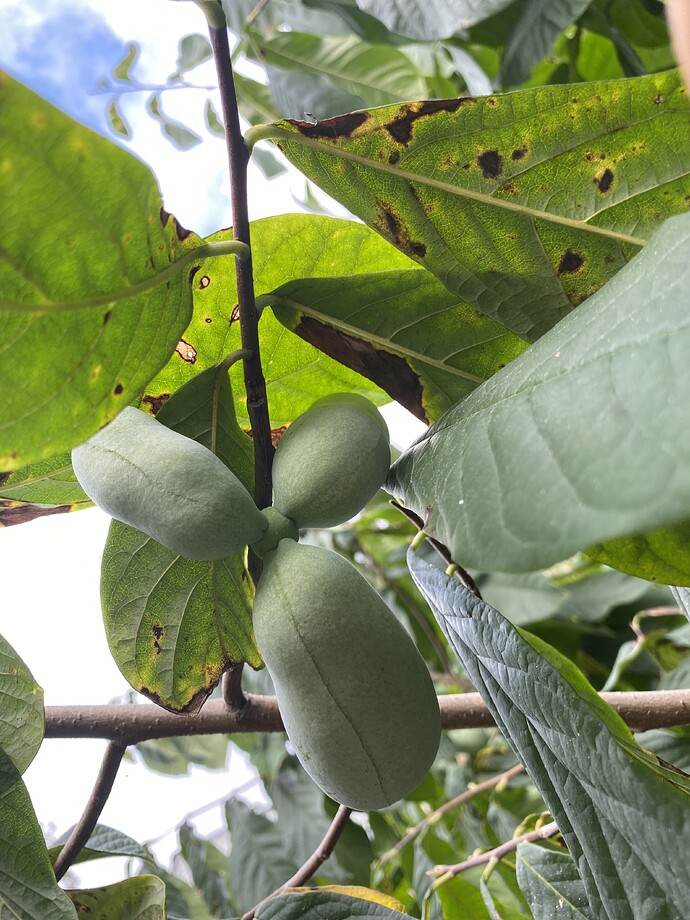
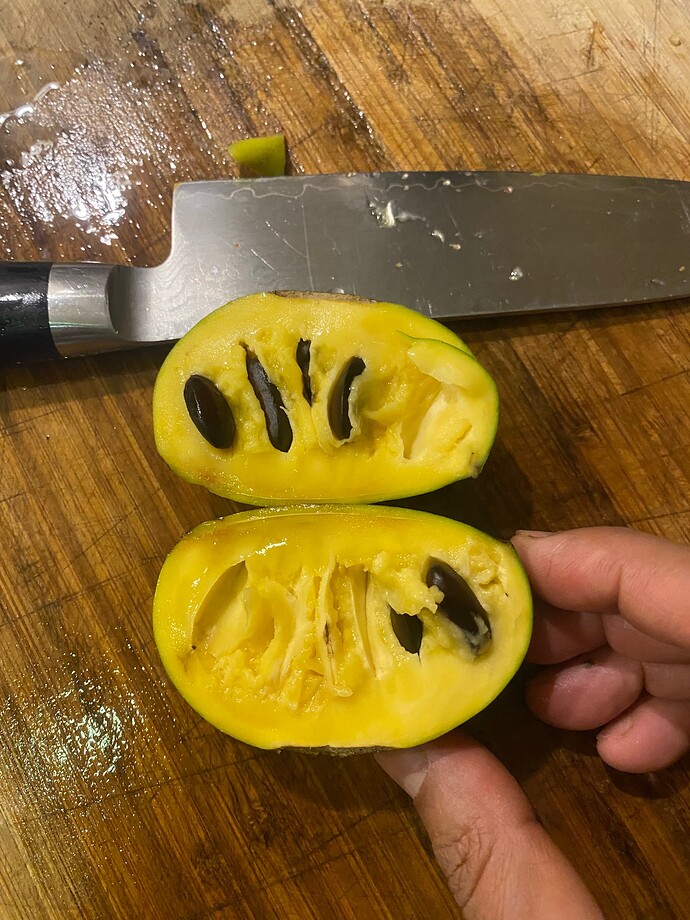
Taste: a recurring characteristic — “strong fruity flavor, very pleasant, with minimal aftertaste”; reviews call it “super fruity”, “very sweet and smooth”, “little aftertaste”. This is a primary reason for its popularity. Fruit Size: public sources report “medium–large”, approximately 140–225 g depending on conditions. Texture: creamy, typical of quality pawpaws. Pulp Color: creamy-yellow. Seeds: gardener reviews often mention a “low seed count” (15-20%), adding convenience for consumption/processing. Skin Color: green, turning light yellow-green upon ripening.
Ripening Times
Few precise official ripening dates for Danae’s Creekside are publicly available. Estimated: mid-season (August–September in central/northern US states). In regions with short growing seasons (e.g., northern edges of zone 5), fruits typically ripen if the summer is warm, but exact dates depend on local climate.
Tree Growth, Size, and Fruiting
Typical appearance: a multi-stemmed shrub or small tree, reaching an adult height of ≈4–6 m (depending on pruning). Saplings typically enter fruiting 3–5 years after planting. Reviews describe the variety as “reliable” and behaving as a typical wild-origin selection in cultivation. Annual yield at maturity: 9–13 kg.
Pollination
Standard pawpaw rule: cross-pollination (another genetically distinct individual nearby) or manual pollination is required for stable, high yields. This applies to Danae’s Creekside. For best results, plant 2–3 varieties with overlapping bloom periods.
Cold Hardiness and Climatic Suitability
Danae’s Creekside is sold/recommended even for colder areas (e.g., northern US nurseries and UK nurseries reporting successful growth). Thus, it is suitable for temperate climates, though fruiting success remains dependent on local summer/autumn warmth.
Disease and Pest Resistance
No public reports of specific weaknesses exist for Danae’s Creekside — sources instead emphasize the natural “resilience” of wild-origin selections. Typical pawpaw risks (leaf spot in wet years, local pests) are managed with standard agro-technical measures.
Gardener Reviews and Practical Observations
Mostly positive: people praise the taste and low seed count; several gardeners noted successful fruiting in northern/cooler regions. Forums show the variety is loved for its “clean” fruity flavor and “light” pulp.
Controversies and Uncertainties
Origin: some registries mark it as material related to Corwin Davis (1959), while others as a find by Tyler/Danae Halvin or a wild selection from northern Missouri. This may imply multiple local “Creekside” selections or inconsistent registration history. Consider this uncertainty if seeking a “genetically confirmed” mother specimen. Quantitative data (weight, yield): lack of large-scale measured statistics — most data are descriptive or from private gardeners.